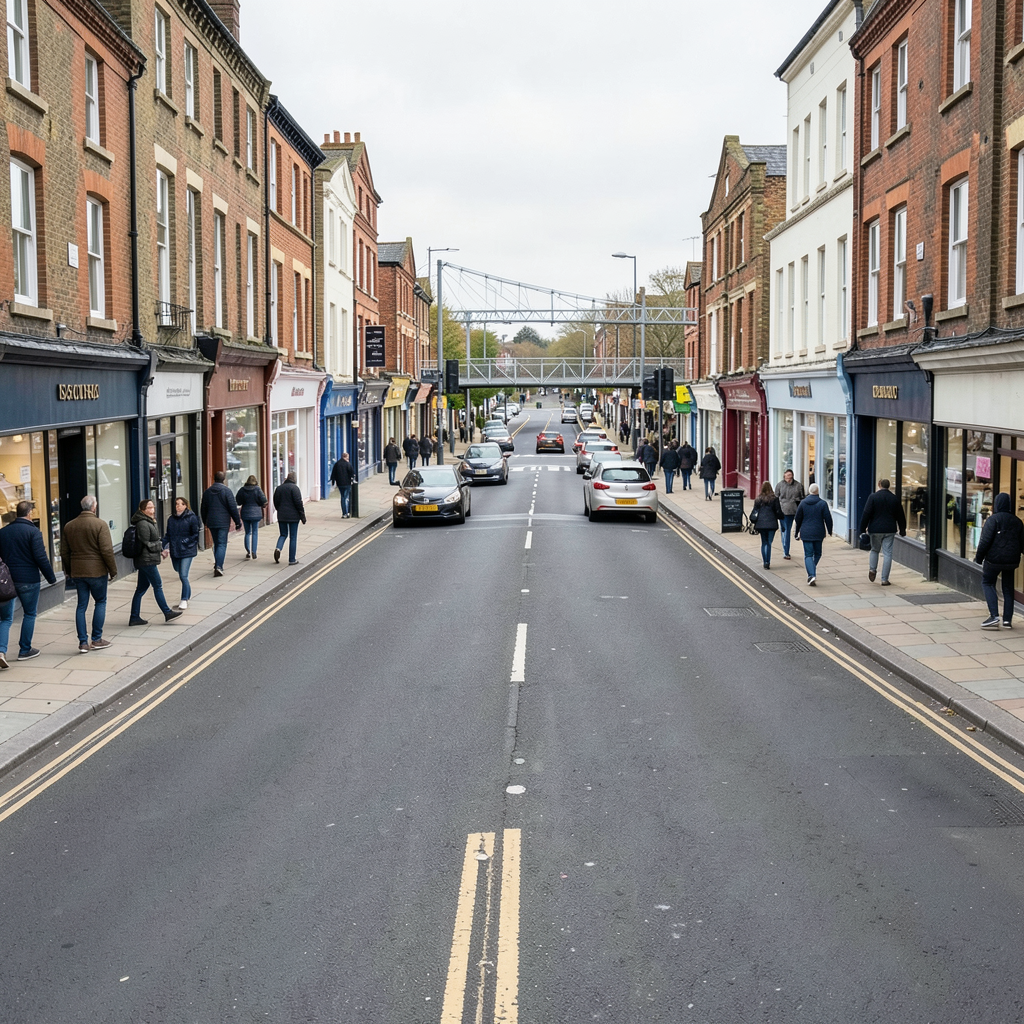

Transport infrastructure changes in Leeds have caused significant disruption to the city centre and prompted shoppers from surrounding areas to seek alternatives, according to a Bradford representative.
Ralph Cohn, a Conservative councillor for Airedale, told a West Yorkshire Combined Authority meeting that while Leeds had long attracted shoppers from the Bradford District, recent traffic reduction measures, including new cycling infrastructure, were driving visitors toward locations such as Skipton and Harrogate instead.
Cohn expressed concern that the city risked economic damage if similar schemes continued to be implemented.
The Investment Committee gathered to consider the Westgate Connector proposal, a £5.8 million initiative designed to establish a continuous cycling route while improving pedestrian facilities around the Westgate Gyratory.
The plans also include converting several busy pedestrian crossings to signal-controlled systems.
Supporting documentation indicated that students comprised a substantial proportion of the local population, with nearly two-thirds of households in the affected area without vehicle access.
Cohn argued that the scheme represented poor value for residents across West Yorkshire.
He stated that while Leeds held significant importance, recent transport modifications had caused considerable harm.
Visitors from his constituency were reducing trips to Leeds and using local amenities less frequently, preferring destinations nearer to home.
He expressed particular concern that recent changes had failed to serve those they were intended to assist, noting that a family member who relied on public transport now required an additional quarter of an hour to reach Leeds and consequently opted to visit nearer locations instead.
Cohn warned that continuing on this trajectory risked serious consequences for the city.
The West Yorkshire Mayor, Tracy Brabin, who chaired the proceedings, indicated that efforts to improve access to Leeds were being addressed through tram development and bus franchising initiatives.
She acknowledged that residents needed better connectivity with the city, emphasising the importance of the tram project not merely for commuters between Leeds and Bradford.
While acknowledging differences of opinion regarding active travel, she thanked Cohn for his candour.
Simon Pope, the authority’s Transport Capital Programme Director, clarified that the proposals would add only a minimal amount of time to car journeys during specific periods.
Brabin affirmed the authority’s commitment to Vision Zero, an initiative aimed at eliminating road deaths across West Yorkshire, noting that the scheme would enhance safety for students travelling to and from educational institutions.
Leeds Councillor Salma Arif of the Labour Party stated that residents in Gipton and Harehills would benefit from safer routes to their places of study.
She highlighted that in that particular neighbourhood, the majority of residents did not own vehicles and depended on city centre employment, making such improvements valuable for the community.
Councillor Ian Eglin from Reform representing Baildon questioned whether the shift toward cycling infrastructure would simply displace vehicle traffic onto other roads.
Pope responded that surrounding routes had sufficient capacity to accommodate any redistribution of traffic.
Brabin noted that Leeds City Council intended to emulate Bradford’s approach to air quality management.
She pointed to evidence that since Bradford’s Clean Air Zone was introduced, there had been a notable decrease in medical appointments for children suffering from respiratory conditions, a development she described as reassuring for local families.
The funding allocation for the Leeds proposal received approval.
Construction work is scheduled to commence the following month, with completion anticipated by late October 2027.