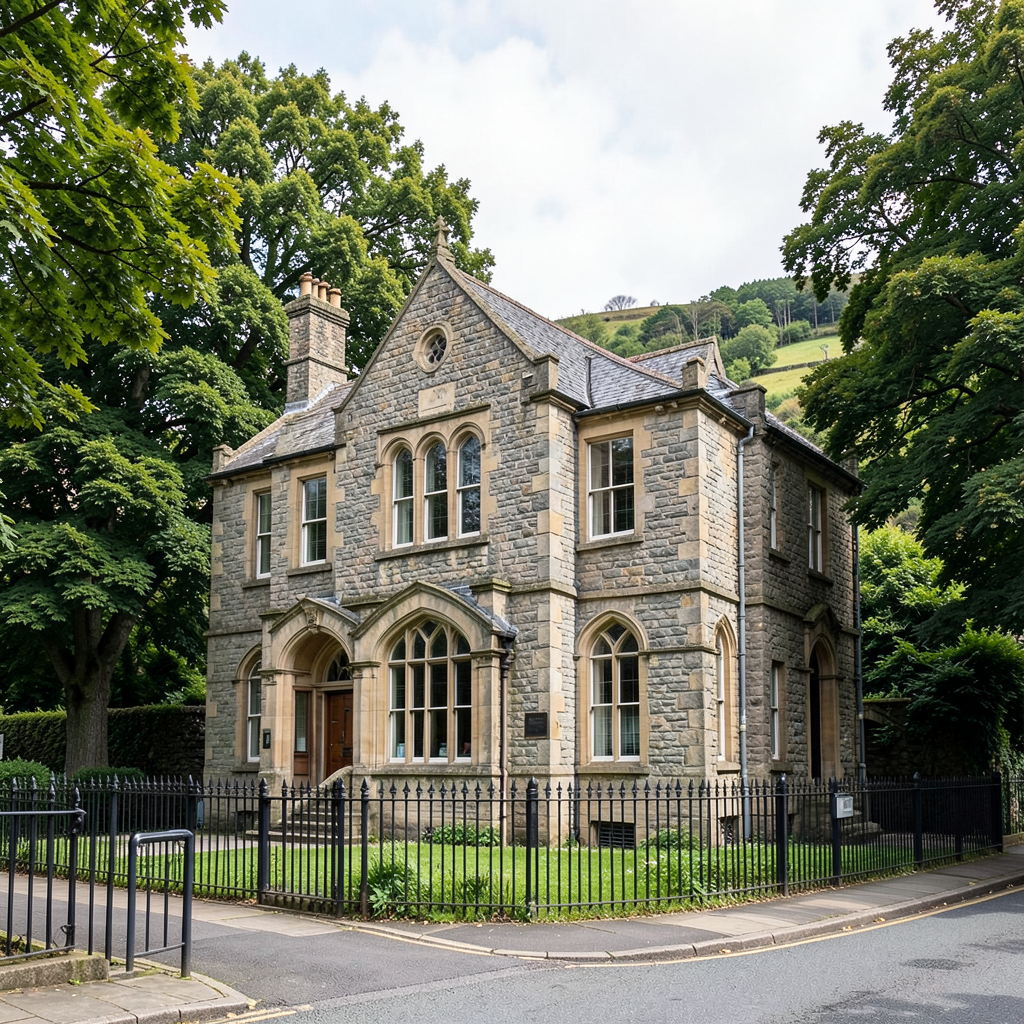

Prior to 1970, the Keighley area operated three distinct medical facilities: St John’s, Victoria, and Morton Banks.
The region had lacked any hospital provision until 1868, when a modest Infirmary commenced operations within the Union Workhouse situated on Oakworth Road.
That institution exclusively served those classified as paupers, while remaining residents requiring medical attention had no alternative but to arrange treatment privately at their own residences.
The confines of that early medical establishment quickly revealed themselves insufficient for the community’s requirements.
This situation prompted construction of a substantially larger Union Infirmary along Fell Lane.
The structure occupied expansive grounds featuring fruit trees and ornamental plantings, officially opening its doors during June 1875.
Throughout that summer month, patients underwent staged relocation from the Workhouse premises to the newly completed facility.
The institution faced its inaugural crisis the subsequent year when a smallpox outbreak struck Keighley.
The epidemic proved severe in its impact, prompting administrators to admit numerous individuals beyond the pauper classification for treatment under the supervision of Dr Percy Milligan, the Infirmary’s appointed medical officer.
Coinciding with the Fell Lane establishment’s opening in 1875, authorities secured a dwelling on Highfield Lane for conversion into a cottage hospital.
The property served principally as a centre for emergency medical intervention.
Highfield Villa, as the residence was known, had previously belonged to Aaron Iveson, a linen draper who passed away in 1874.
The building contained a kitchen, dining area, and reception space at ground level, with five bedrooms positioned on the first floor and additional accommodation located in the attic storey.
Financial support for the cottage hospital’s operations derived from public charitable contributions and proceeds generated by annual fundraising galas held within the town.
Notable benefactors included John Pickles Heaton, a worsted manufacturer who contributed funds specifically allocated to furnishing a newly established ward.
The year marking Queen Victoria’s diamond jubilee, 1897, witnessed construction of an additional structure adjoining the existing cottage hospital building.
This extension elevated bed capacity by 44 units, achieving a combined total of 80 beds, and incorporated administrative offices that liberated space within the original cottage facility.
The institution subsequently received designation as Victoria Hospital in commemoration of the monarch.
Further enlargement occurred during the 1904 to 1905 period, followed by subsequent additions comprising additional ward blocks and dedicated accommodation for nursing staff.
The eventual medical complex occupied nearly three acres of land positioned between Drewry Road and Cartmel Road in the Highfield Lane vicinity.
Neither the Union Infirmary nor Victoria Hospital possessed the structural characteristics necessary for managing outbreaks of infectious disease.
This circumstance necessitated development of a separate isolation facility at Morton Banks in Riddlesden.
That establishment commenced operations in January 1897, featuring dedicated isolation accommodation, a fever treatment pavilion, administrative offices, laundry facilities, and a porter’s residence.
Its initial major responsibility involved managing typhoid outbreaks that emerged independently in Kildwick during 1898 and in Oakworth during 1899.
While numerous Kildwick patients received domestic care, 15 individuals from Oakworth required admission to the new institution.
The Kildwick outbreak ultimately resulted in 51 fatalities, though every infected individual in Oakworth survived the illness.
Between 1914 and 1919, the Union Infirmary and Morton Banks Isolation Hospital underwent requisition for military purposes, with supplementary hutted accommodation erected on both sites to house injured servicemen.
Where circumstances permitted, soldiers from regional regiments received treatment at these facilities, reflecting a philosophy that familiar surroundings and family contact might accelerate recovery.
Morton Banks bore the primary burden when the Spanish influenza pandemic reached Keighley in 1919 via returning infected troops.
The facility notably admitted German prisoners of war who contracted the illness, with 42 such individuals succumbing at that location.
Following the conflict’s conclusion, the Union Infirmary received rebranding as St John’s Hospital, eventually developing specialisation in maternity and geriatric services.
Victoria maintained operations as a general hospital, while Morton Banks continued functioning as an isolation facility throughout the 1960s.
In 1970, all three institutions ceased operations, with patient services consolidated at the newly constructed Airedale General Hospital situated at Steeton.