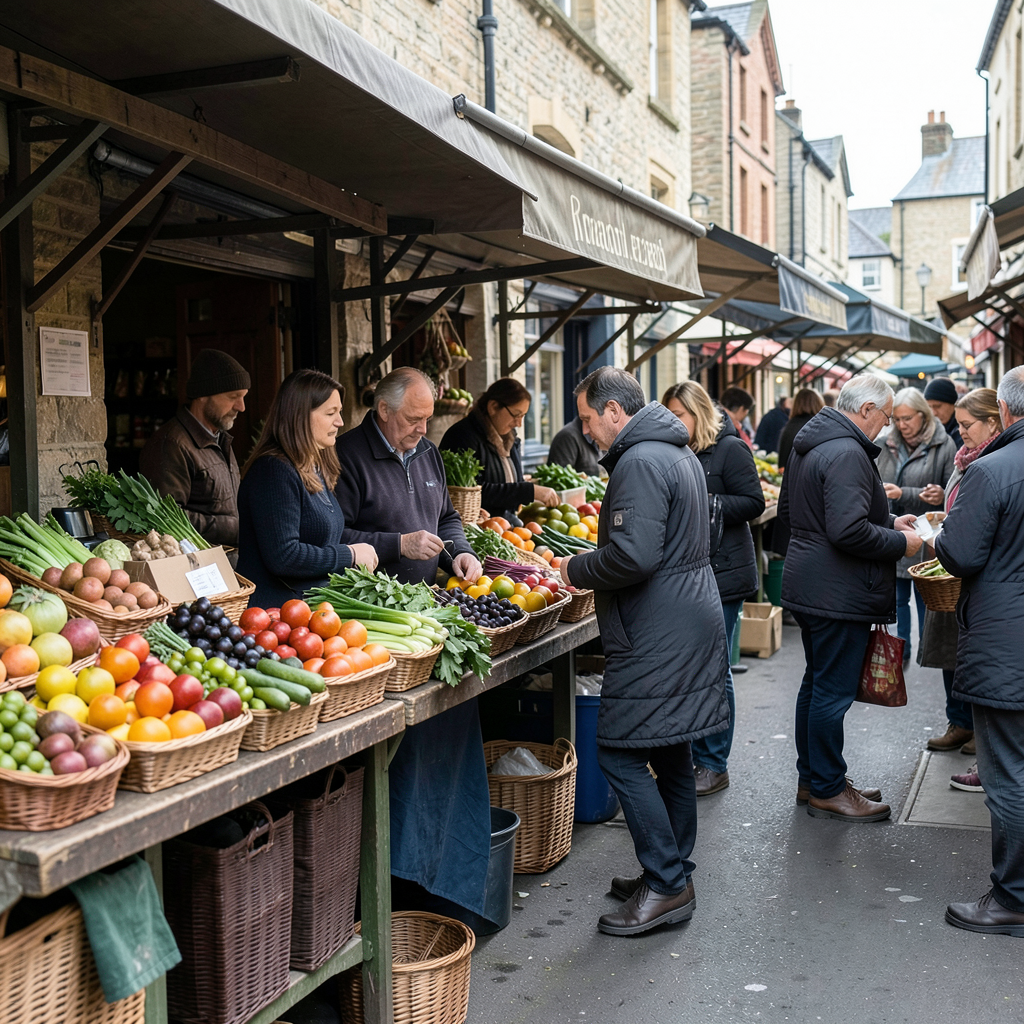

For many years, visiting Bradford’s central shopping district meant travelling to the city’s markets.
This served as the primary purpose for such trips into town.
Across successive generations, these local trading venues provided opportunities to purchase fresh produce, acquire an extensive selection of affordable and practical items, negotiate over costs, and most importantly, sit down to enjoy a traditional meal.
Bradford’s market heritage stretches back considerably.
A royal charter authorising a Thursday trading day was awarded in 1251, while the contemporary period emerged alongside the expansion of outdoor trading spaces during the 1800s.
The prominent Kirkgate Market, conceived by the architectural practice of Lockwood and Mawson, commenced operations in 1872.
Featuring impressive construction and an intricate arrangement of commercial units, it established itself as one of the urban area’s most treasured structures.
The remarkable variety of standard goods available demonstrated an almost unbelievable breadth.
Countless rows of establishments offered textiles, footwear, sweets, provisions, publications and recorded music.
The venue functioned as a comprehensive retail destination rather than merely a food destination.
Rawson Place Market concentrated on provisions.
By the closing decades of the previous century, in excess of twenty meat traders competed alongside seafood specialists whose displays featured products ranging from salmon to sand eels.
John Street Market, finished in 1930, represented another thriving commercial venue.
Originally operating in the open air, it served for many years as an additional focal point for consumers and vendors.
Over subsequent periods the location underwent reconstruction and the market adapted to contemporary circumstances.
Substantial renovation work concluded in 2002, resulting in its designation as the Oastler Shopping Centre, honouring Richard Oastler, the 19th-century industrial reform campaigner from Bradford.
Eventually the premises accommodated more than market-style trading, with retail units and refreshment establishments enhancing its appeal.
These venues provided access to authentic Yorkshire cuisine, much of which has now virtually vanished from regular purchasing options.
Hey’s establishment at Rawson Place, specialising in tripe, built its reputation on variety meats and black puddings that earned competition accolades.
Shifting consumer preferences ultimately led to its closure.
Nevertheless, for numerous customers, the principal attraction following morning shopping was a substantial midday meal.
Nothing characterised the Bradford market experience quite like its pie establishments.
Prominent among these was the outlet within Kirkgate Market.
Compact, confined and entirely modest in appearance, it achieved legendary status among local shoppers as the venue to stand or sit, frequently packed alongside fellow customers, and consume pastry cases filled with peas.
A portion of meat pastry, softened peas and mint-based condiment, accompanied by tea, constituted a familiar routine.
Those seeking more adventurous options could include black pudding.
Located on Ivegate, another pie establishment earned comparable affection, particularly celebrated for pork pastries and cakes prepared with dripping.
Staff members at the Treasury Loans’ Office would send junior employees to join queues of other young workers to purchase these fatty cakes for the male staff members.
On the last commercial day prior to the Christmas period, the lines of waiting customers extended considerably along the thoroughfare as individuals sought large pastries intended for consumption on the day following Christmas.
Situated behind Kirkgate Market on Godwin Street, another pie vendor’s standing became intertwined with JB Priestley following damage sustained during a German aerial assault in 1940.
The author referenced the occurrence during one of his notable wartime radio addresses, recounting the hot meat-and-potato pastry that remained visible in the harmed shopfront.
He employed this imagery to represent the fortitude of northern communities throughout the bombing campaign.
Regrettably, to its lasting detriment, the city permitted the destruction of the impressive Victorian-era Kirkgate Market in 1973 to facilitate construction of a modern retail development.
Characterising the choice as contentious would understate the matter significantly, and the significant act of cultural destruction proceeded despite widespread community campaigns and demonstrations.
Particularly irritating was the apparent failure to absorb lessons from the 1960s, when an initial wave of destruction claimed notable structures including the Swan Arcade and the Mechanics’ Institute.
Happily, certain original ornamental iron components endured.
Entrance gates and decorative sections were preserved by the local authority following demolition and subsequently underwent restoration.
These elements now constitute features of the recently established Darley Street Market, establishing a physical connection with the Victorian market that previously occupied the adjacent area.
Rawson Market persisted for a greater duration.
By the 1990s, urban renewal schemes and evolving conditions were placing mounting strain on the established market and its commercial tenants.
Retail practices were transforming as well.
Large self-service stores provided ease and expanded operating schedules, while shifting preferences rendered specialised trading units increasingly challenging to maintain.
These market environments bustled with activity throughout daylight hours.
Vendors announced their pricing, growing more insistent as closing time approached.
The aroma of unprepared meat filled the atmosphere, and shoppers navigated crowded passages carrying brown-paper packages that occasionally leaked moisture.
The establishments, market locations and trading traditions formed integral components of Bradford’s daily existence.
They satisfied the nutritional requirements of the local population, yet also generated recollections that have endured well beyond the disappearance of the actual commercial spaces themselves.