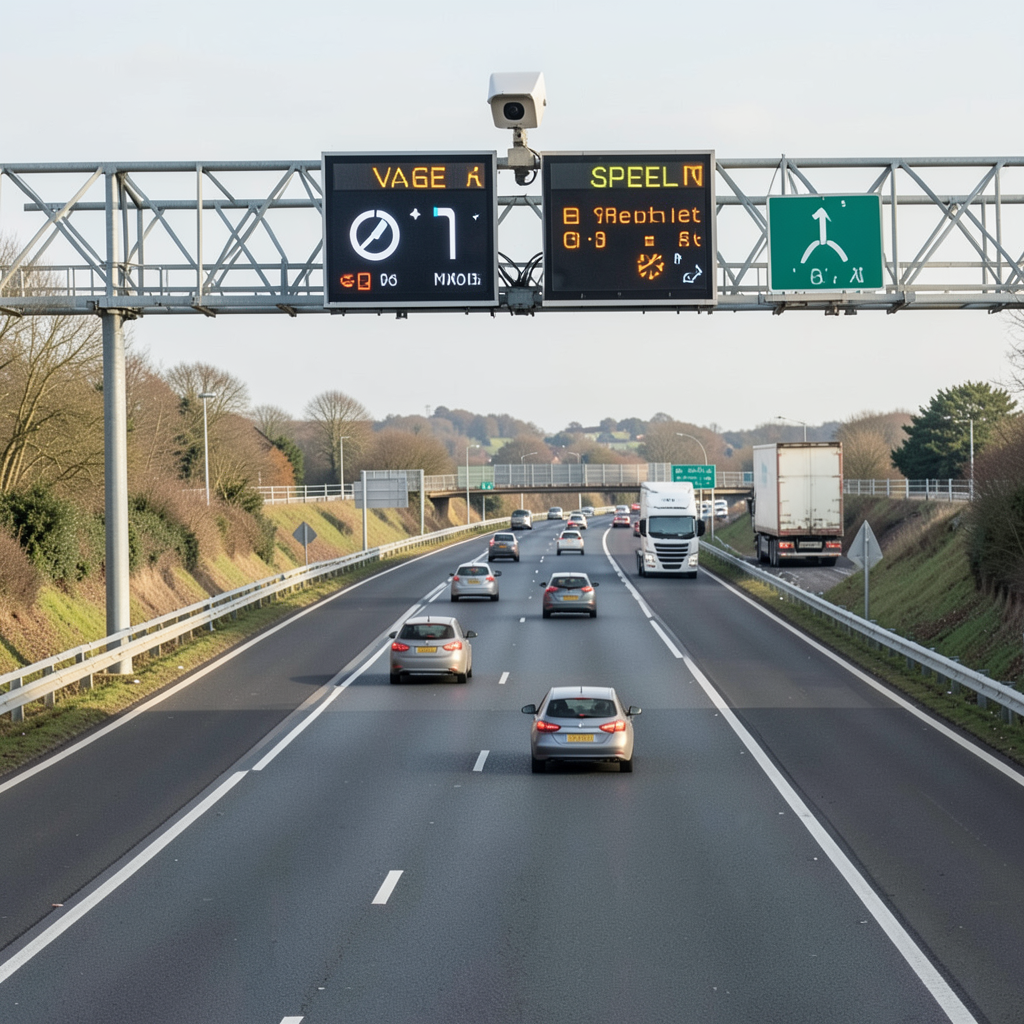

Road users in the Bradford area have been alerted to a persistent misconception regarding smart motorway enforcement that could result in significant financial penalties.
Highway safety specialists indicate that numerous motorists operate under the false assumption that automated speed monitoring devices on intelligent motorway networks function only during designated operational periods.
This misunderstanding may expose drivers to substantial fines, penalty points on their licences, and potential driving bans.
Industry representatives have emphasised the importance of drivers recognising that speed enforcement technology remains operational continuously, cautioning against relying on outdated beliefs.
Graham Conway, a specialist from the vehicle leasing company Select Car Leasing, highlighted that a noteworthy proportion of motorists continue to hold the belief that cameras on smart motorways do not enforce limits when variable speed displays are inactive.
According to experts, this assumption is incorrect, as gantry-mounted cameras are capable of documenting instances where motorists exceed the national 70mph limit even when no variable restriction is indicated.
Conway noted that many drivers understand the requirement to reduce speed when encountering matrix signage displaying reduced limits such as 50mph or 60mph, but erroneously conclude that speeding violations cannot be detected at other times, provided no police presence is visible.
This perception is fundamentally flawed.
Accounts from road users who have received penalties in such circumstances are frequently discussed on internet motoring communities.
The consequences for breaching speed regulations on motorways can be considerable, in addition to the obvious safety risks posed to other road users.
Smart motorways have emerged as a significant component of Britain’s road infrastructure, providing enhanced capacity and more efficient traffic management.
These adaptable road systems incorporate variable speed restrictions designed to regulate traffic movement and improve safety standards, implementing adjustments based on prevailing traffic conditions, incident occurrences, or maintenance work.
Speed monitoring devices operate through radar detection or sensor technology embedded in road surfaces to assess vehicle velocity and document evidence of any violations.
While earlier models relied on photographic film, contemporary equipment employs fully digital recording systems capable of monitoring a vehicle’s average speed across extended distances.
These electronic systems capture the following information: the speed at which the vehicle was travelling, the precise time and location of the detected offence, the vehicle’s registration mark, and the applicable speed restriction for that road section.
In certain circumstances, such devices can also obtain clear photographs of the driver and any passengers present in the vehicle.
Contrary to widespread belief, no standardised legal provision establishes a tolerance threshold of ten percent plus two miles per hour.
Specialists from BigWantsYourCar.com have stressed that the notion of immunity from enforcement when travelling at 35mph in a 30mph zone represents one of the most prevalent misconceptions encountered.
From a legal standpoint, drivers become liable to penalties immediately upon exceeding the posted limit by even a single mile per hour.
While the National Police Chiefs’ Council does advocate a ten percent plus two mile per hour guideline to allow discretion among officers, this recommendation does not constitute a statutory tolerance and may vary according to the specific enforcement zone or the officer assessing the case.
Guidance from the RAC organisation indicates that legislation requires drivers to be considered liable for fines from the moment they surpass the posted limit, meaning that travelling at 31mph in a 30mph zone or 71mph on a motorway constitutes an offence potentially attracting financial penalties.
The organisation emphasises that the specific outcome depends entirely on the officer who detects the violation, with discretion regarding whether to issue a fine or pursue alternative action.
The most prudent approach is to ensure compliance with posted speed restrictions at all times.
A frequently encountered belief concerns the requirement for mobile speed monitoring units to remain visible.
No statutory provisions mandate visibility, meaning officers are not legally prevented from conducting enforcement operations in darkness.
However, such units generally prefer visibility, maintaining that their presence serves as an effective deterrent.
Go Safe Casualty Reduction Officer Gareth Thomas explained that legislation does not impose visibility obligations, though fairness, educational objectives and accident prevention remain priorities.
Regarding the practice of flashing headlights to warn other road users of speed enforcement vehicles, motorists should be aware that this could potentially constitute an offence.
Section 89 of the Police Act 1997 establishes that deliberately obstructing a police officer in the execution of their duties constitutes a criminal offence.
Thomas observed that while this remains a technical offence, establishing proof presents considerable difficulties.
The primary objective of speed enforcement remains educational rather than punitive.
The specific consequences following detection depend on the particular circumstances and the degree to which the posted limit was exceeded.
The minimum financial penalty for speeding on British roads stands at 100 pounds.
In certain situations, police authorities may offer motorists the opportunity to attend a speed awareness programme as an alternative to incurring penalty points and fines.
An accredited course is considered more likely to modify driver conduct and thereby improve road safety standards.
These programmes are accessible to drivers who respond promptly to official notifications and whose recorded speed did not exceed the posted limit by more than ten percent plus nine miles per hour.
For instance, any motorist travelling at more than 86 miles per hour on a motorway would not qualify for the awareness course option.
Eligibility also requires the driver to hold a clean licence at the time of detection, and those who have already completed such a course within the preceding three-year period would be unlikely to receive this alternative offer.