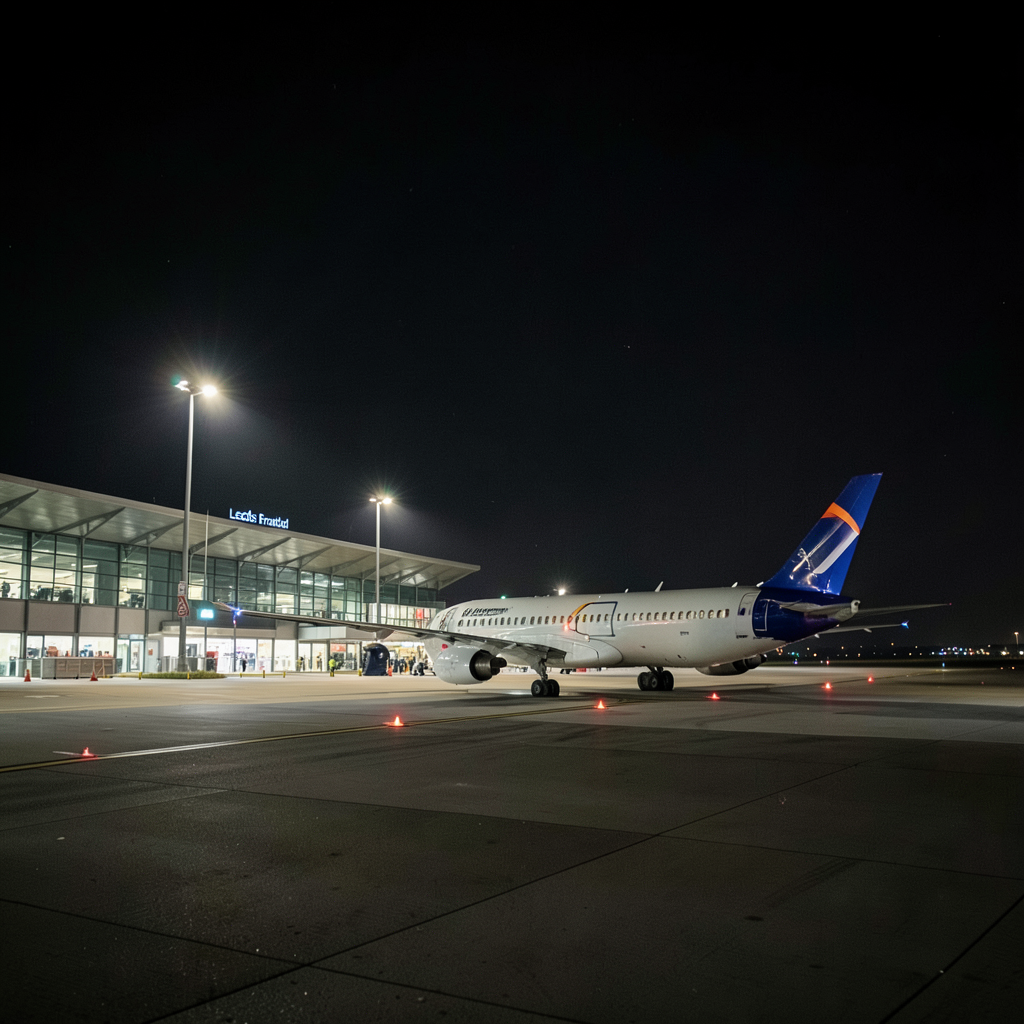

Plans to alter regulations governing overnight aircraft movements at Leeds Bradford Airport have attracted fresh criticism from local residents and community representatives.
The West Yorkshire airfield is pursuing amendments to existing planning restrictions that currently control night-time operations.
The proposal centres on the adoption of a quota count mechanism designed to restrict cumulative noise output rather than directly limiting the volume of take-offs and landings.
Airport management contends that such a framework would provide airlines with incentives to operate aircraft equipped with quieter, more advanced engine technology.
The development also encompasses a realignment of the designated night period, which would commence at 11.30pm and conclude at 5.59am, alongside the establishment of a financial assistance programme to help neighbouring households install noise reduction measures.
Vincent Hodder, chief executive of Leeds Bradford Airport, stated that the facility was undergoing a transformation into a contemporary international hub serving the Yorkshire region and acting as a driver for broader economic development across the area.
According to the chief executive, substantial private sector investment combined with environmental commitments and engagement with surrounding communities was establishing an airport infrastructure appropriate for future requirements.
The executive emphasised that the objective centred on delivering enhanced regional connectivity and sustainability rather than the significant expansion of night-time movements some critics had suggested.
The specific quota count system being submitted would, he explained, maintain the existing noise exposure boundaries while redistributing how those limits were applied.
Opposition to the proposals has emerged from environmental advocates and elected local representatives.
Nick Hodgkinson, chairman of the Group for Action on Leeds Bradford Airport, expressed concern that the amendments could result in a notable increase in overnight aircraft movements to the disadvantage of local inhabitants.
The campaign group representative clarified that their position did not amount to calling for the complete cessation of operations at the airfield, but rather opposition to permitting a further substantial growth in night-time services.
In May, regulatory approval had been granted for an additional 941 night flights, representing a 77 per cent increase during the peak summer period, and the airport was now seeking a further 75 per cent rise in summer overnight movements.
This approach was deemed unfair to those residing in the vicinity.
The chairman disputed the airport’s contention that economic considerations necessitated the modifications.
While promotional materials distributed by the airport emphasised economic advancement, the formal planning submission acknowledged that expansion would proceed regardless of whether the night flight regulations were altered.
Projections within the application indicated anticipated passenger volumes of seven million annually by 2030 irrespective of any changes to overnight flight restrictions.
Employment figures cited within the submission originated from the airport’s own commercial strategy document for 2030, which contained no reference to a requirement for modifying night-time operational limitations.
The economic benefits claimed by the airport, he argued, would materialise without any amendment to the existing rules.
Health implications were also highlighted by the campaign group representative.
Substantial medical evidence had established connections between regular exposure to nocturnal aircraft noise and cardiovascular conditions.
The central concern regarding the airport’s submission was its request for authorisation to operate considerably increased frequencies of overnight flights and movements between 6am and 7am.
The potential consequences for public health were described as substantial.
Horsforth Town Council registered reservations while recognising the airport’s economic contribution to the area.
The authority’s joint planning, licensing and transport committee advised Leeds City Council that any response should emphasise requirements for enhanced soundproofing provisions for householders, expanded transportation and terminal infrastructure to accommodate growing passenger volumes, and increased utilisation of lower-emission aviation fuel.
However, the council expressed serious reservations regarding the proposed night-flight modifications and cast doubt on whether the quota count system would genuinely result in reduced aircraft noise.
The existing night-flight window should be maintained to prevent additional disturbance to local residents, the council stated.
Rather than formally supporting or rejecting the application, the authority advocated for more robust protective measures for the community.
The airport has offered to fund soundproofing improvements for approximately 750 properties, though the campaign group contends this number falls short of requirements and would leave numerous households without assistance.
The group noted that the airport proposed only to contribute partially towards insulation expenses and that implementation would extend to roughly 100 residences annually, meaning many householders would face considerable delays before receiving protection.
The campaign group reported that public response to the plans had been predominantly unfavourable.
Records on Leeds City Council’s planning portal indicated 1,182 submissions objecting to the scheme alongside 168 expressions of support.
The period for public consultation on the airport’s application has been prolonged, with residents now afforded until 15 October 2026 to submit their observations.