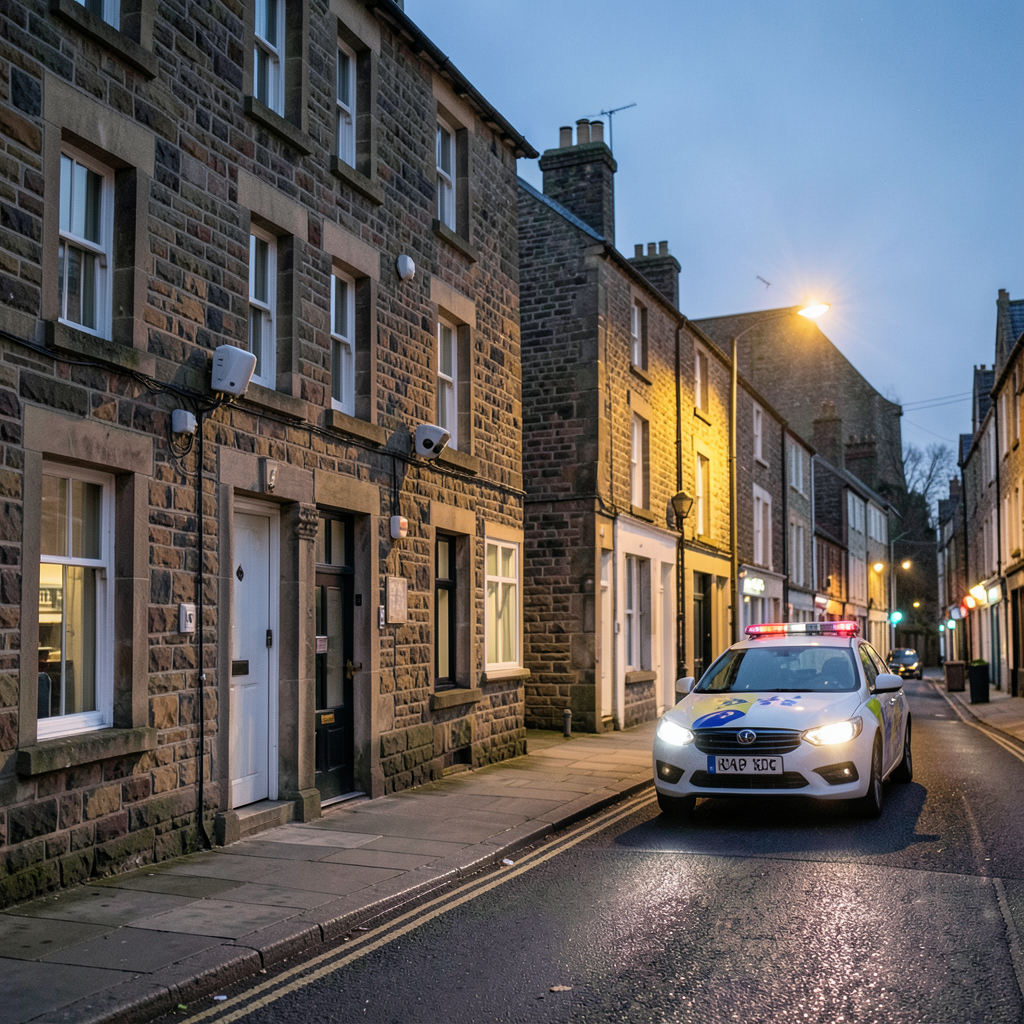

A property data analysis has identified Bradford as the Yorkshire district with the most significant serious crime rates, according to figures compiled by Crystal Roof using information from the official police database.
Over the period spanning twelve months up to July 2026, the district logged 72,853 criminal offences.
This translates to a rate of 120 incidents per 1,000 individuals classified as at-risk, considerably exceeding the regional average of 106 per 1,000.
The methodology employed by Crystal Roof classifies high-harm offences as those with the most severe consequences for victims.
This approach deliberately excludes widespread but less impactful categories such as anti-social behaviour and retail theft.
Crime levels in the district reached their highest point at 145 per 1,000 in 2018.
Subsequent measurements showed a rate of 124 per 1,000 in 2025, with the most recent twelve-month period recording 120 per 1,000.
West Yorkshire Police have challenged these findings.
Crystal Roof representatives attribute the discrepancy to two primary factors.
First, their total encompasses all categories published on the police database, including anti-social behaviour.
Force-recorded crime statistics typically exclude such incidents as they are classified as non-notifiable rather than formal offences.
In Bradford, these amount to approximately 7,000 cases annually, which alone could account for a difference of several thousand.
Second, Crystal Roof employs the Bradford local authority boundary, whereas the police force may be operating within a more confined geographic area.
Within the district, considerable variation exists between neighbourhoods.
The most hazardous ward experiences roughly six times the criminal activity recorded in the most secure area.
The City ward leads with 178 total offences per 1,000 at-risk residents.
Tong follows with 137 per 1,000, while Eccleshill records 136 per 1,000.
Conversely, Wharfedale demonstrates the lowest rate at 31 per 1,000, with Ilkley and Addingham slightly higher at 35.1 per 1,000.
These ward-level statistics reflect overall criminal activity rather than specifically serious offences.
Responses from city centre residents proved largely uncooperative.
A male visitor at Darley Street Market stated he commutes to the area solely for employment purposes and considers himself secure within the commercial district.
Market traders reported that older shoppers have become increasingly reluctant to visit due to visible substance users congregating in the central area.
Vendors also described the need for constant vigilance against opportunistic thieves.
A 48-year-old business proprietor supported these observations, noting that patrons appear apprehensive about safety.
He described the market as having an unmistakable odour of narcotics, with a colleague resorting to fragrance application to counteract the smell.
The presence of loitering groups explained why individuals experienced feelings of intimidation.
The proprietor expressed concern about the absence of visible patrol activity and believed criminal activity was damaging commercial viability.
In the Tong Street neighbourhood, a recently relocated mother disputed comparisons suggesting the area compared unfavourably with locations like Dewsbury.
She characterised conditions as uniformly challenging across regions.
Conversations with residents became noticeably reluctant whenever criminal activity was mentioned.
A local businessman declined to elaborate on local circumstances.
A woman accompanied by her child expressed a desire to relocate immediately if financially feasible, citing two recent homicides in the immediate vicinity.
A male shopper observed that surrounding villages experience targeting from individuals originating from Tong Street and the adjacent Holme Wood estate, attributing this to a reluctance to commit crimes in one’s own neighbourhood.
He expressed concerns about insufficient parental control over young people.
Within the Holme Wood estate, Bradford’s largest residential development, residents refused to identify themselves when questioned.
Explanations offered for this caution included references to property damage and personal safety risks.
One female resident stated she maintained a positive view of her neighbourhood despite acknowledged crime and deprivation levels.
She considered the removal of national service particularly damaging to societal discipline.
Like other respondents, she indicated that witnessing criminal activity would prompt avoidance rather than intervention, with the notable exception of assisting elderly individuals, for which she expressed willingness to accept potential legal consequences.
Investigations extended to Greengates, situated within the Eccleshill ward.
A female shopper engaged extensively on the topic, acknowledging elevated drug-related criminal activity while emphasising that solutions extended beyond assigning blame to authorities.
She characterised the challenge as a complex societal problem lacking straightforward remedies, referencing racial and social tensions.
Xander Ford, aged 33, relocated to Bradford approximately ten years ago to pursue university education.
Having resided in multiple areas throughout the district, he expressed surprise at Eccleshill’s elevated crime ranking.
He acknowledged personal observation of criminal incidents and noted that female acquaintances reported discomfort navigating the B&M parking facility after dark.
He expressed concern that community social media groups amplified perceptions of criminal prevalence, with images of entirely innocent individuals being shared.
He advocated for public education to counter discriminatory associations.
Ford suggested increased recreational facilities for young people as a potential response to district-wide crime challenges.
Council representatives were approached for response.
A West Yorkshire Police official acknowledged awareness of community concerns and outlined ongoing efforts to sustain recent decreases in offending.
The force emphasised adherence to Home Office recording standards in line with other policing organisations.
Preliminary figures indicated 64,692 recorded offences in Bradford between July 2025 and 2026, representing a five percent reduction from the preceding twelve months.
Neighbourhood policing units continue engagement at community level while specialised officers address significant criminal activity.
Notable recent operations resulted in the detention and charging of three males with drug-related offences following proactive enforcement led by the force’s county lines taskforce.
Joint operations with local neighbourhood teams resulted in the seizure of heroin and crack cocaine with an estimated street value exceeding £100,000.
Additional activities encompassed targeted drug enforcement in the city centre, knife crime reduction initiatives, and supplementary evening patrols to support the local economy.
Facial recognition technology has been implemented seventeen times in the city centre, producing 29 arrests.
The force continues to solicit crime reports from residents and encourages anyone with concerns regarding criminal activity or anti-social behaviour to contact officers through the 101 telephone number or online reporting options.