
A Reform UK councillor’s claim to be establishing a neighbourhood ranger programme in Wyke has attracted significant political opposition, with opposition members describing the initiative as potentially hazardous to community safety.
Councillor Ian Reed has stated that the scheme is being developed in conjunction with Nottinghamshire Safer Streets, an organisation established to address local criminal activity, anti-social behaviour, and violence targeting women and girls.
Nottinghamshire was among the areas that received Home Office funding for Safer Streets initiatives, though that financial support concluded during 2024.
The programme has not operated under the Safer Streets banner since that time, and similar initiatives exist across multiple regions throughout the country.
The councillor has expressed concern regarding women’s safety, retail crime, county lines operations, and groups of young people apparently lacking alternative activities.
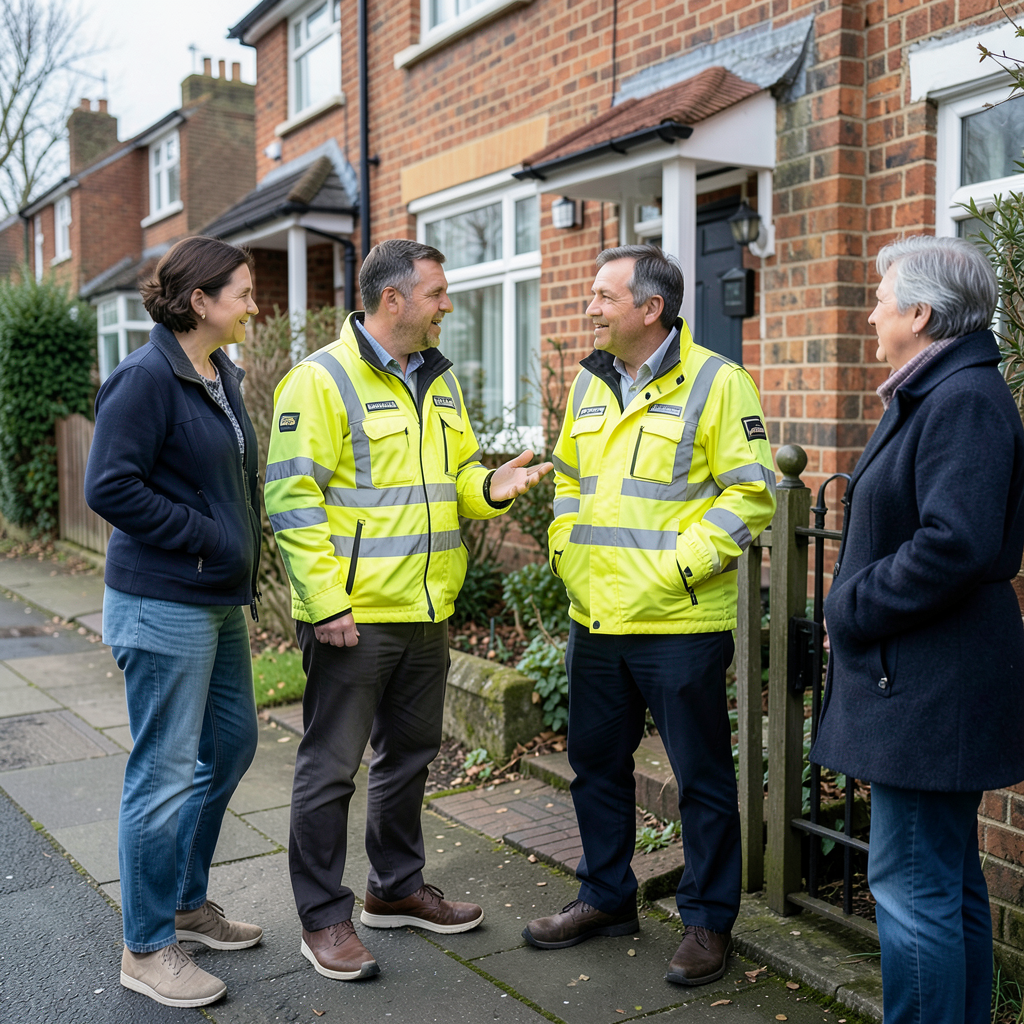
On social media platforms, he distributed an image depicting two neighbourhood rangers wearing paramilitary-style uniforms, accompanied by explanatory text.
The Reform UK representative, who has identified himself as a former police officer, described the community policing concept as intended to take back the town centre and indicated that local officers were supportive of the approach.
Leaders from various political groups have registered their objections to the proposal.
Councillor Alun Griffiths, who leads the Liberal Democrat group on Bradford Council, characterised the initiative as potentially misguided populism or, alternatively, a form of perilous vigilantism.
Councillor Rebecca Paulson, leading the Conservative group on the same council, advised that elected members should concentrate on developing productive working relationships with their local Neighbourhood Police Teams to address key concerns collaboratively, describing this as a far more constructive alternative.
Councillor Reed indicated that Nottinghamshire Safer Streets were currently preparing a proposal for a six-month trial in his ward, with possible expansion throughout the Bradford district, though he acknowledged the initiative would not operate under council administration.
When questioned about practical implementation, he stated that all participants would undergo thorough background checks and would comprise respectable members of the community, specifically mentioning ex-police and military personnel as suitable candidates.
He outlined that the programme would initially consist of a single paid coordinator supported by volunteers equipped with body cameras and two-way radio communication devices.
He emphasised that any volunteer acting improperly would represent an undesirable outcome.
He indicated that logistics were still being arranged with police authorities, with the expectation that anti-social behaviour would be addressed verbally by volunteers who had received police guidance, that criminal matters would be referred directly to officers, and that advisory concerns would be channelled through the area coordinator.
He praised Nottinghamshire Safer Streets as highly effective and suggested that those involved carried restraints.
Research conducted by this publication indicates that restraints were not in fact carried by members of that organisation.
Councillor Imran Khan, leading the Labour group on Bradford Council, observed that the purpose and scope of the proposed volunteer force remained ambiguous, questioning whether relevant police partners and statutory agencies had been consulted prior to the public announcement.
Residents he had engaged with wished to see adequately resourced police, council services, and partner organisations empowered to address anti-social behaviour effectively, rather than independent volunteer groups taking enforcement action independently.
The appropriate approach involved building robust local partnerships with support from regional and national government committed to restoring public services.
Councillor Hawarun Hussain, Deputy Leader of the Green group on Bradford Council, stated that whilst public safety was a universal priority, deploying untrained volunteers in police-style attire was not the solution.
Community safety constituted serious professional work that should remain with established policing authorities, and individuals assuming law enforcement functions independently undermined the very mechanisms that maintained public security.
Councillors bore a responsibility to communicate honestly with residents rather than creating anxiety or endorsing proposals lacking proper consideration.
West Yorkshire’s Deputy Mayor for Policing and Crime, Alison Lowe OBE, observed that Wyke residents were justified in expressing concerns regarding anti-social behaviour and its effects on their communities.
The emphasis should centre on supporting and enhancing the work already delivered by West Yorkshire Police, local authorities, Neighbourhood Watch schemes, and other partner organisations to ensure a coordinated and effective response.
Collaboration through existing established services would improve visibility, address priority concerns, and help communities feel safer and more assured.
This publication sought additional information from Councillor Reed regarding the scheme, but no response was received to the request for further details.