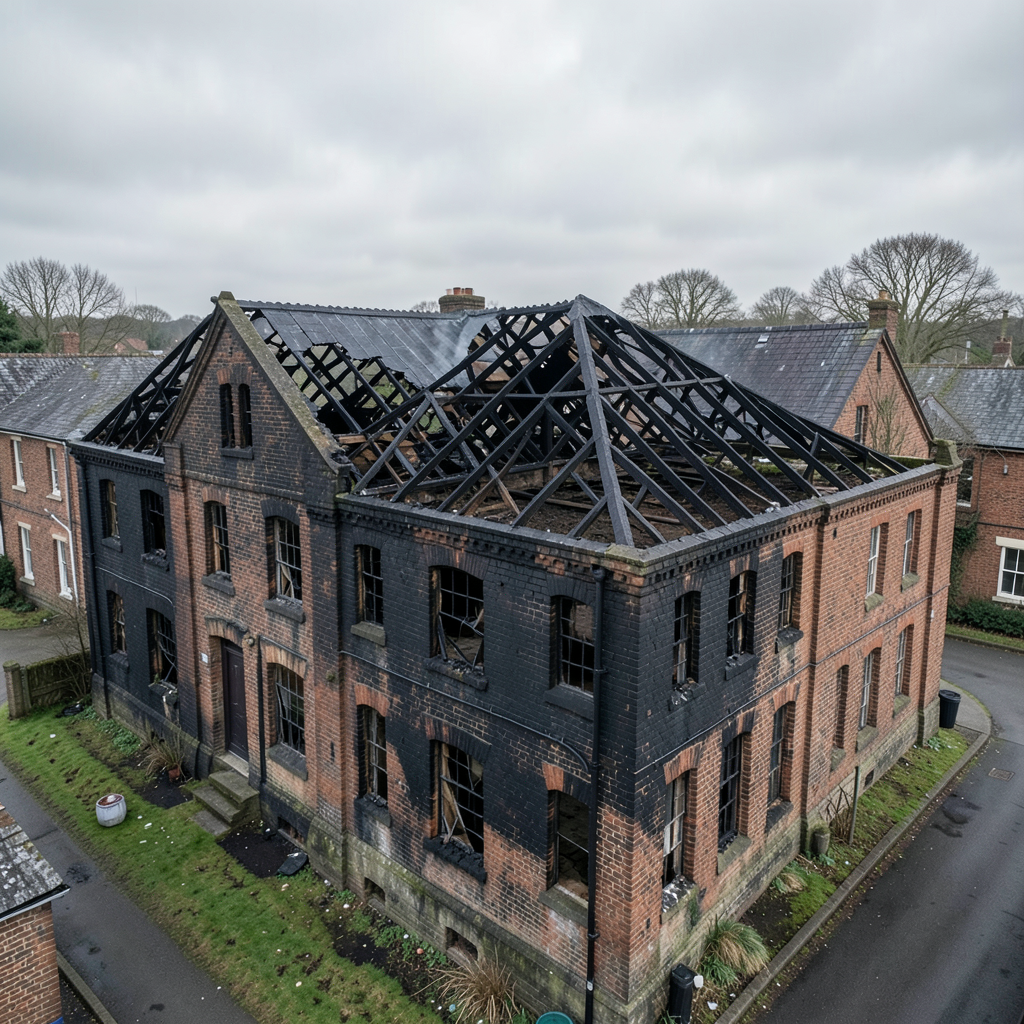

Dalton Mills in Keighley has suffered another blaze, marking the fifth such incident at the site within five years, with conservationists warning the historic complex may be lost forever.
The Victorian Society has expressed concern that the fire-damaged complex is joining a collection of nationally important textile mills that are being permitted to fall into disrepair.
Thomas Ollivier, the organisation’s Northern Conservation Advisor, observed that Dalton Mills exemplifies a broader pattern of mill deterioration occurring throughout the country.
The complex has remained unoccupied for an extended period, a situation which Ollivier noted frequently leads to unwanted urban exploration activity and anti-social behaviour at such locations.
The Grade II* heritage designation attached to Dalton Mills underscores both its cultural and architectural importance.
Ollivier highlighted that structures bearing this classification are uncommon, describing the mill as particularly impressive for its type.
He pointed to distinctive surviving features, including the chimney stack, which he characterised as an unusual survivor given the age of the building.
While fires represent a visible threat, Ollivier emphasised that the failure of local authorities to intervene represents the more fundamental problem.
He described the recurring incidents as entirely preventable yet continuing to occur.
The conservation adviser outlined various potential uses for such buildings, noting that mills can successfully be repurposed as residential dwellings, hotel accommodation, fitness facilities and commercial office space.
Ollivier acknowledged the inherent tension surrounding disused industrial sites, describing them as simultaneously burdensome on emergency service resources yet holding substantial historical significance.
He remarked that mills possess the advantage of extensive open floor areas, creating possibilities for adaptive reuse.
The broader picture across the Bradford district over recent decades reveals an inconsistent approach to historic mill preservation.
Several complexes have undergone successful regeneration schemes resulting in residential or commercial developments.
Salts Mill stands out as a particularly celebrated example, now home to arts venues, restaurants and retail establishments.
The conversion of Victoria Mills into 449 apartments ensured another significant mill building remained standing, while the transformation of Lister Mills in Manningham preserved one of Bradford’s most iconic structures, having once held the distinction of being the world’s largest silk manufacturing facility.
The redevelopment of Conditioning House at Forster Square received recognition as Best Residential Development Yorkshire for 2018/19.
However, the district has also experienced considerable losses.
Drummond Mill, representing more than 150 years of Bradford’s industrial heritage, was consumed by fire on 28 January 2016, with the ten-acre Manningham site reduced to ruins within days.
Approximately 125 fire crews were deployed to combat the inferno, necessitating the closure of Lumb Lane and the evacuation of nearby residents.
Concerns have also emerged regarding Barkerend Mills, where a significant fire broke out in May 2025.