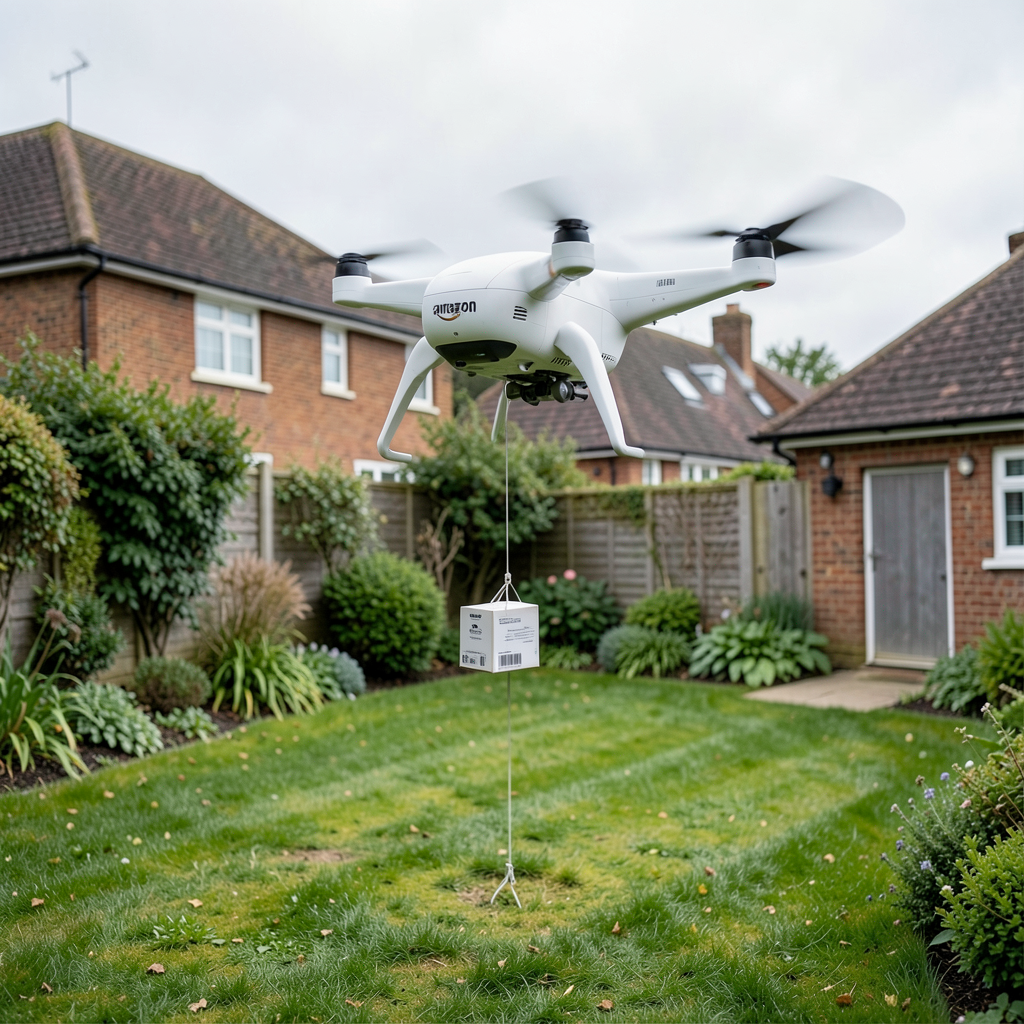

The technology company is on the verge of significantly extending its airborne delivery operations throughout the United Kingdom, with regulatory clearance to serve the entire Darlington area anticipated shortly.
Presently, the programme functions on a restricted basis in the County Durham location, where qualifying customers can receive selected purchases deposited in outdoor spaces such as gardens, yards or driveways within a two-hour window.
Following more than 500 successful aerial flights and deliveries, the company has submitted an application to the Civil Aviation Authority requesting authorisation to roll out Prime Air across the entirety of Darlington, which could establish a foundation for broader expansion throughout Britain.
The head of the delivery initiative has indicated that approval appears imminent, with the long-term goal of extending coverage to additional regions nationwide.
The service commenced operations in Darlington during February after the town was selected as the British testing hub, marking the inaugural deployment of Prime Air beyond American borders.
The unmanned aircraft have already demonstrated an impressive capability to complete deliveries in exceptionally short timeframes.
The fastest delivery recorded at the facility thus far reached just 39 minutes from order placement.
Current limitations restrict availability to customers residing within a 7.5-mile radius of the Darlington facility.
Purchases must not exceed 5 pounds in weight and must fit within a container comparable in size to a large shoebox.
Additionally, customers require suitable outdoor space for aerial drop-offs.
Company data indicates approximately 68 percent of typical customer orders meet the dimensional and weight criteria.
During the purchasing process, customers view satellite imagery of their property, with the company’s mapping and artificial intelligence systems identifying appropriate delivery zones.
Shoppers can subsequently select from suggested locations and receive guidance to maintain clear landing areas.
No additional fee applies for drone delivery among British Prime subscribers at present, though this arrangement may evolve as the service develops.
Company representatives indicated that pricing structures remain under consideration but would not represent a substantial additional expense.
Proponents argue that rapid delivery represents the primary benefit of airborne logistics compared to traditional road-based transportation.
During an inspection of the Darlington facility, executives emphasised the straightforward nature of these advantages, noting that the company had achieved an average completion time approaching 34 minutes across nearly a million deliveries in the United States.
The methodology proves particularly effective for single-item orders where timing coordination presents fewer challenges.
Additional benefits cited include reduced road congestion and environmental sustainability.
Customer feedback consistently indicates that expedited delivery remains a priority.
The prospect of numerous delivery drones operating simultaneously raises safety considerations.
An inquiry commenced in July after an unmanned aircraft collided with a garden while completing a delivery in Darlington.
The company reported no injuries and indicated preliminary findings suggested an object protruding from a vehicle roof unintentionally struck the aircraft during the delivery sequence.
Company representatives stated the drone executed its emergency protocols appropriately and landed without incident.
The programme director confirmed that isolated incidents had occurred but emphasised such events remained statistically infrequent.
Safety engineering incorporates redundant systems and maintains continuous control capability throughout all flight phases to meet regulatory requirements.
The latest drone models have been engineered to minimise visibility from ground level.
At altitudes approaching 400 feet or 130 metres, the aircraft blend against the sky and prove difficult to distinguish.
Operational limitations apply during adverse weather conditions, with a scheduled demonstration for local representatives cancelled due to strong winds.
The vehicles have been certified for operation in light precipitation, snowfall and wind gusts up to approximately 28mph, though conditions must remain suitable for flight like any aerial operation.
Darlington presently serves as the sole British testing location, though the company clearly regards the technology as having potential for far more extensive domestic deployment.
Customer responses to the initiative have been overwhelmingly positive, with users expressing appreciation for obtaining desired items without requiring vehicle travel.
Common order categories include everyday necessities such as infant formula and personal electronics.
The immediate priority involves securing authorisation to expand coverage throughout Darlington, which if granted as anticipated, would provide a substantially larger testing environment for the company’s ambition of transporting everyday purchases from distribution centres directly to customers via aerial routes.