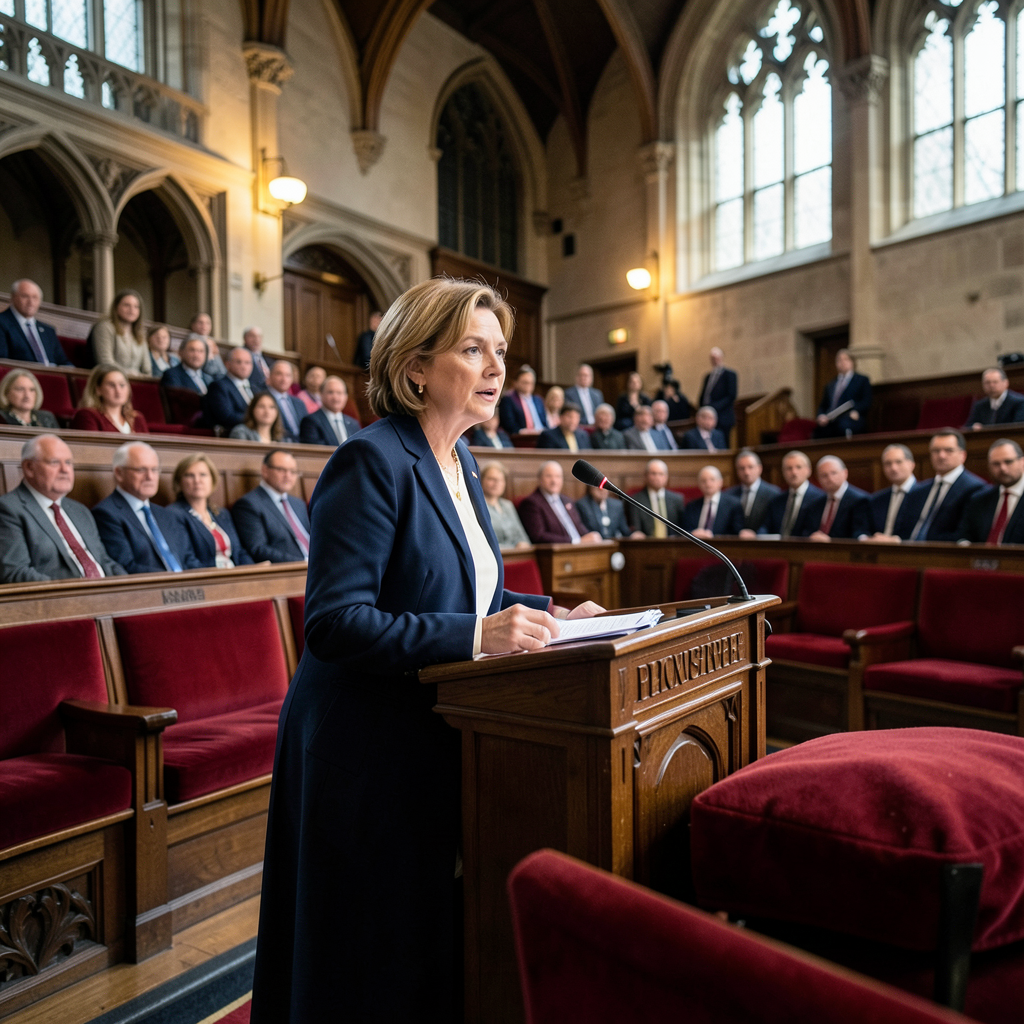

Former cabinet minister Baroness Therese Coffey has urged the government to scrap the state pension triple lock and replace it with an alternative system.
The Suffolk MP, who served as work and pensions secretary from 2019 to 2022, made the call during a House of Lords debate on Friday.
She expressed preference for a double lock mechanism rather than the current arrangement.
The triple lock guarantee was established by the Conservative-Liberal Democrat coalition in 2010.
The policy commits the government to raising the state pension annually by whichever measure rises most sharply: the consumer prices index, average earnings growth, or a minimum floor of 2.5 per cent.
Baroness Coffey argued that the triple lock often receives unwarranted criticism for broader policy shortcomings.
She suggested a double lock could prove more appropriate, noting that the 2.5 per cent floor had originally been introduced to accelerate the pace at which pensions recovered their value relative to average earnings.
She acknowledged that this objective had largely been achieved.
Her remarks emerged during discussion of a committee report assessing whether the United Kingdom is adequately prepared for population ageing.
Members from across the political spectrum used the debate to call for the triple lock policy to be revisited.
Conservative peer Lord Tugendhat acknowledged the arrangement had served a necessary purpose when first introduced but insisted it should now be abandoned without delay.
Crossbench peer Lord Turnbull, a former head of the civil service, offered more direct criticism, describing the mechanism as fundamentally unsound.
He characterised the system as producing unpredictable and fortunate outcomes that always favour pensioners, driven by the particular movement of earnings and prices in any given year.
Lord Turnbull cited Office for Budget Responsibility analysis indicating the policy could ultimately cost an additional two per cent of gross domestic product.
Labour peer Lord Reid of Cardowan argued the report should address the triple lock with greater directness and challenge.
However, Conservative peer Lord Redwood expressed regret at suggestions the policy might be ended, crediting it with contributing to reductions in pensioner deprivation.
Labour peer Lord Liddle, who introduced the report, admitted feeling somewhat uneasy that the document failed to tackle the triple lock question more explicitly, though he stated it was evident the arrangement required scrutiny.
He warned that the absence of any published strategy on ageing suggested the government would prefer to avoid confronting these issues as an urgent priority, leaving the United Kingdom severely unprepared for future challenges.
Treasury minister Lord Pitt-Watson confirmed the triple lock featured as a Labour manifesto commitment and would remain in place until the end of the current Parliament.