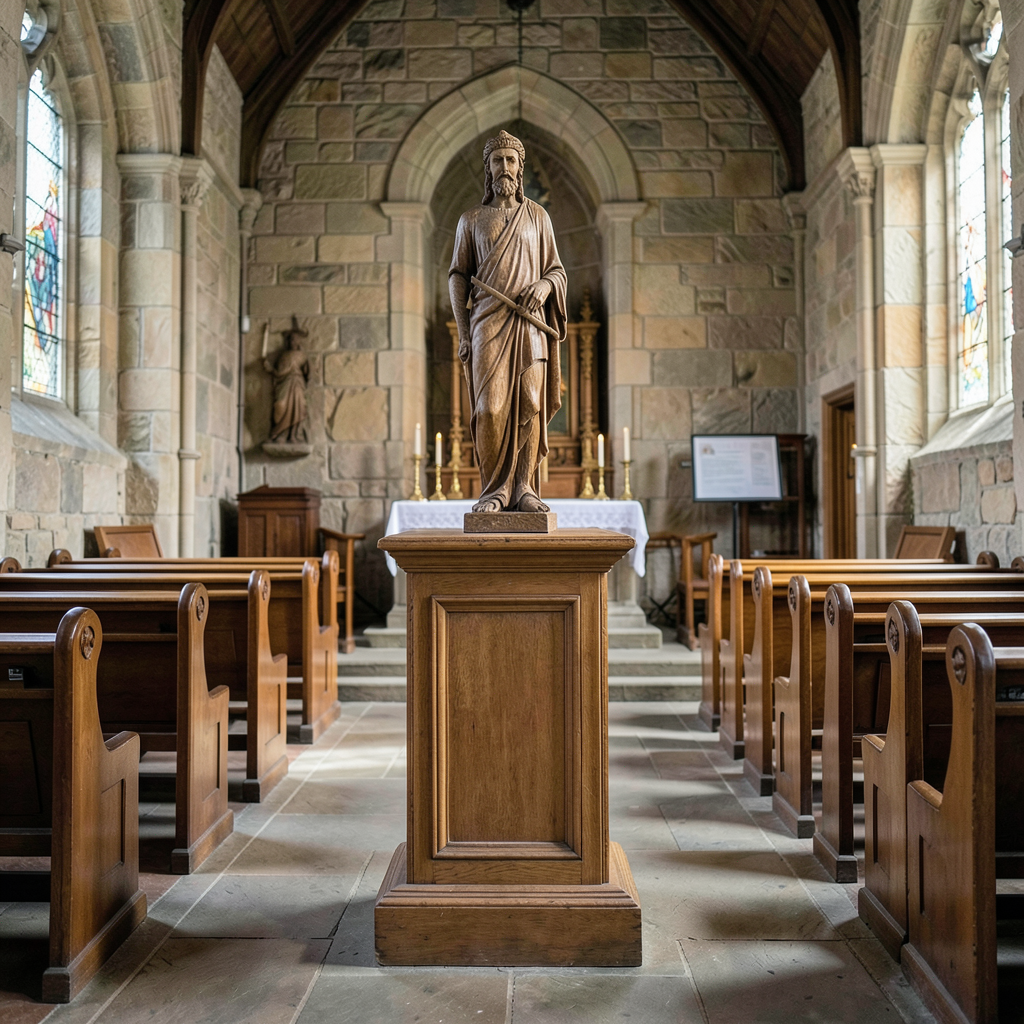

A church official has set a deadline of 5pm on September 4 for the return of a carved oak figure representing St Cuthbert that was taken from a place of worship in the Oxenhope area of Bradford.
The artefact, which had occupied its position at St Mary’s Church since 1938, was discovered missing at some point during a 32-hour window between the morning of August 31 and the evening of September 1.
The Reverend Denise Angela Hayes, who serves as vicar at the venue, expressed profound disappointment at the incident, noting that longtime supporters of the congregation had been particularly distressed by the loss.
The place of worship remains accessible to visitors daily between 9am and 5pm, offering a tranquil environment for reflection and prayer.
Members of the local community as well as those visiting the area make regular use of the space and appreciate the stillness it provides.
The Reverend expressed bewilderment at the reasoning behind taking the figure, which carries minimal monetary worth.
According to her, the absence of the item has affected elderly supporters of the congregation deeply.
Those attending services dedicate considerable effort to the upkeep of the building, with numerous individuals in their eighties continuing to handle daily opening and closing duties as well as caring for the interior and exterior spaces.
The Reverend stated that no previous thefts had ever occurred at the location, and that the emotional impact on the older members of the congregation represented the most troubling aspect of the incident.
She questioned what could have motivated someone to remove the representation of St Cuthbert, whether the act stemmed from a practical joke or from a belief that the piece might possess significant value.
The missing sculpture forms part of a collection of carved figures that have occupied the Grade II listed building for over eight decades.
The depiction of St Cuthbert, shown holding the head of King Oswald of Northumbria, has been in position for almost ninety years.
The Reverend emphasised that the figure, like all the other sculptures within the building, constitutes an essential component of the church’s historical legacy and holds significant importance for those who worship there.
Church officials indicated that the piece occupied a prominent position on a shelf positioned above the central communion table.
Despite being crafted from substantial timber and secured with screws, the item had been forcibly removed from its mounting.
No damage was left behind at the scene, and no additional items were reported missing.
The figure stands approximately two feet in height, making it difficult to conceal or transport discreetly.
In response to the incident, the church has established a period during which the item may be handed back without any repercussions.
The Reverend indicated that anyone who may have taken the piece as part of a wager or act of mischief would be given the opportunity to restore it before the Friday evening deadline.
She suggested that individuals sometimes act without fully considering the outcomes of their choices, and expressed hope that whoever removed the item might reconsider and decide to bring it back.
St Cuthbert was a religious figure who lived during the seventh century in the Northumbrian region, serving as both a monk and bishop before eventually becoming a hermit.
He is regarded as one of the most significant saints associated with northern England.
His spiritual work took him across Northumbria, with periods spent at Melrose and Lindisfarne, before he withdrew to Inner Farne where he passed away in 687.
Following Scandinavian attacks on monastic communities, his remains were transported throughout the area before eventually being relocated to Durham in 995, where a shrine was established that attracted large numbers of pilgrims.
The saint maintained a direct connection with Yorkshire through his time at Ripon, where he served as guest-master at a newly founded monastery during the mid-seventh century, prior to his return to Melrose following St Wilfrid’s assumption of leadership of that community.
His remains were also temporarily housed at Ripon during the same period of Scandinavian invasions before their final journey to Durham.
His enduring significance across the region is evidenced by the dedication of numerous Yorkshire churches to his memory, including locations at Wrose, Fishlake, Crayke and Bolton Abbey.
West Yorkshire Police have received notification of the incident.