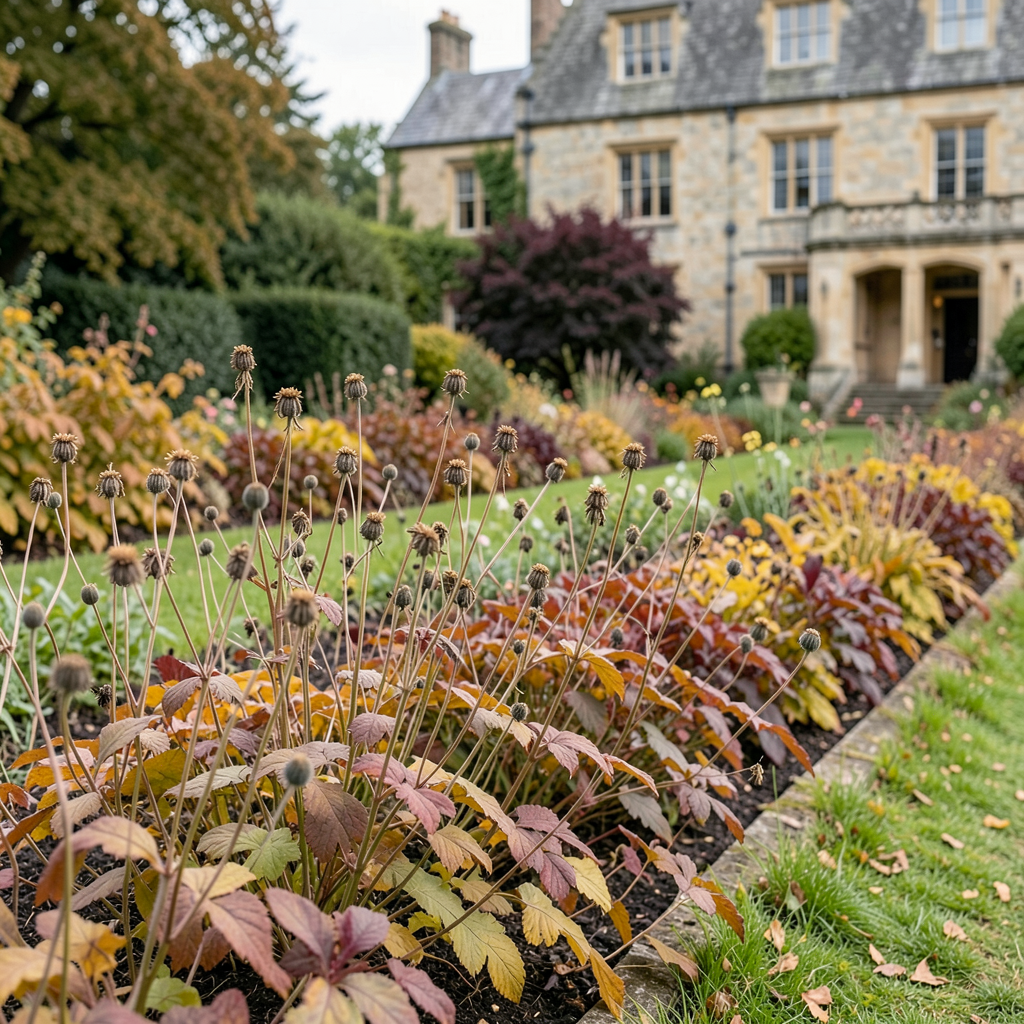

The transition into astronomical autumn remains just days away.
As late summer unfolds, gardens begin to display their authentic character.
The energetic display of June and early July has subsided, revealing something more genuine and enduring.
Hues shift from the vivid palette of early summer toward deeper shades of ochre, burgundy and bronze.
Flower heads give way to seed pods as the primary visual element, while the low angle of evening illumination highlights every stem and grass plume.
This period also showcases hardiness.
Vegetation that has survived heat stress, wind exposure and periods without rainfall proves its rightful place in the planting scheme.
The focus moves away from novelty toward lasting presence.
Throughout Yorkshire, numerous outstanding landscapes achieve their peak condition during this timeframe.
Grassland areas buzz with invertebrate activity, garden boundaries merge seamlessly with adjacent rural terrain and established schemes produce generous displays without appearing excessive.
The late summer garden prioritises overall mood rather than individual blooms.
Visitors are encouraged to adopt a slower pace, to value surface quality alongside pigmentation and to acknowledge a setting that is transitioning toward the autumn months.
Beningbrough Hall Gardens, located in the vicinity of York The contemporary perennial arrangements at Beningbrough demonstrate how current horticultural approaches can address seasonal variation.
Grasses, asters and plants flowering later in the season assume prominence during August, building depth through both pigmentation and kinetic energy.
The grounds receive attentive maintenance while preserving an organic quality, enabling the planting to establish an unforced cadence.
Against the historic hall structure, the bedding areas reveal how framework and ecologically considered planting can coexist effectively, generating an environment that maintains visual interest well past the conventional high summer period.
Himalayan Garden and Sculpture Park, Ripon Set within woodland and undulating rural terrain, the Himalayan Garden attains an alternative form of excellence in late summer.
Established woodland canopy provides shaded sanctuary while open areas and meadows radiate in the late-season illumination.
Aquatic features, woodland and thoughtfully arranged planting work together to establish a sense of calm that complements the time of year ideally.
The grounds illustrate how surface quality, foliage and environmental context can assume equal significance to floral display, presenting visitors with an absorbing encounter during peak summer.
Scampston Hall Walled Garden, Malton Created by Piet Oudolf, Scampston potentially represents Yorkshire’s most accomplished interpretation of late-season planting.
The latter part of summer marks when the garden reaches its full potential.
Grasses tower above flowing perennial groupings, seed heads combine with blooms and the beds grow progressively atmospheric as summer progresses.
Rather than depending on vivid pigmentation, the arrangement showcases surface quality, movement and structural form.
Navigating the meadow garden alongside the contemporary perennial schemes provides an instructive example of how naturalistic planning can sustain aesthetic appeal long after the primary flowering period concludes.
Late summer prompts a revised perspective on garden spaces.
Earlier portions of the year concentrate on emergence and blooming.
The concluding phase of summer rewards examination of structural elements.
Seed pods acquire ornamental value.
Grasses advance toward the focal point.
Herbaceous specimens that might have appeared unremarkable during spring suddenly demonstrate their worth.
The garden shifts from emphasis on individual specimens toward focus on the interactions between them.
This represents the point where naturalistic planting demonstrates its strengths.
Rather than reaching a dramatic pinnacle before declining, it undergoes continuous development.
Blooms yield to seed, new green tones deepen into richer variations and kinetic energy grows progressively significant.
Air movement through grass can rival any floral display in visual appeal.
Local wildlife similarly attains its seasonal maximum.
Pollinators persist in visiting late-season nectar sources, lepidoptera remain active during warm afternoons and avian species commence utilizing developing seed as a food supply.
For those maintaining gardens, late summer can serve as a period of monitoring rather than active management.
The urgency to sow, divide or establish new plantings diminishes.
Instead, an chance emerges to assess which elements have performed well and which have encountered difficulties.
Perhaps this accounts for the contemplative quality of late summer.
The garden functions as a chronicle of the season, revealing not merely what has grown but how it has reacted to meteorological conditions, ground composition and the passage of time.
In doing so, it provides insights applicable to future seasons.
The appeal of established planting A tendency exists to interpret August as marking a conclusion.
School vacation periods approach their end, evenings shorten almost without notice and those tending gardens begin directing attention toward autumn.
Yet the late summer garden presents an alternative viewpoint.
Rather than deterioration, it delivers completion.
This represents the season when planting exposes its complete sophistication, when grasses catch illumination at their most attractive and when grassland areas pulse with activity.
Perhaps this explains the sense of contentment it generates.
The garden ceases its push toward a culminating moment.
It has already reached that destination.
In Yorkshire’s terrain, where farmland, meadow and cultivated grounds frequently merge into a continuous landscape, this interval carries particular resonance.
Pigments deepen, illumination diffuses and the tempo slackens.
If spring embodies anticipation and June embodies plenty, then August embodies maturity – a season that compensates those who have waited and directs attention toward the lasting rather than the initial.
Planting combination Late summer surface quality and structural form Calamagrostis × acutiflora ‘Karl Foerster’ Produces vertical stems that catch evening illumination and maintain their form throughout the season.
Persicaria amplexicaulis Supplies extended-lasting pigmentation, its crimson flowering spikes persisting well beyond numerous herbaceous specimens have declined.
Veronicastrum virginicum Contributes height, elevating delicate flowering spikes above surrounding vegetation and establishing architectural interest.
Echinacea purpurea Provides striking daisy-style blooms followed by structural seed heads that retain their appeal over extended periods.
Molinia caerulea Introduces kinetic energy and seasonal shift, transitioning from fresh green to luminous gold as autumn approaches.
All share essential characteristics: tolerance of wind exposure, resistance to saline conditions and capacity to flourish in lean coastal substrates.
Andrew Jackson Andrew Jackson, based in Beverley, secured the GMG New Talent Award 2025.
Working with newly constructed properties, he authored and established the New Build Manifesto, an initiative advocating for improved access to and enhanced quality of spaces within new developments.
A distinction-winning garden designer, he has featured on BBC Gardeners’ World and holds the position of Writer in Residence at both Helmsley Walled Garden and York Gate Garden.