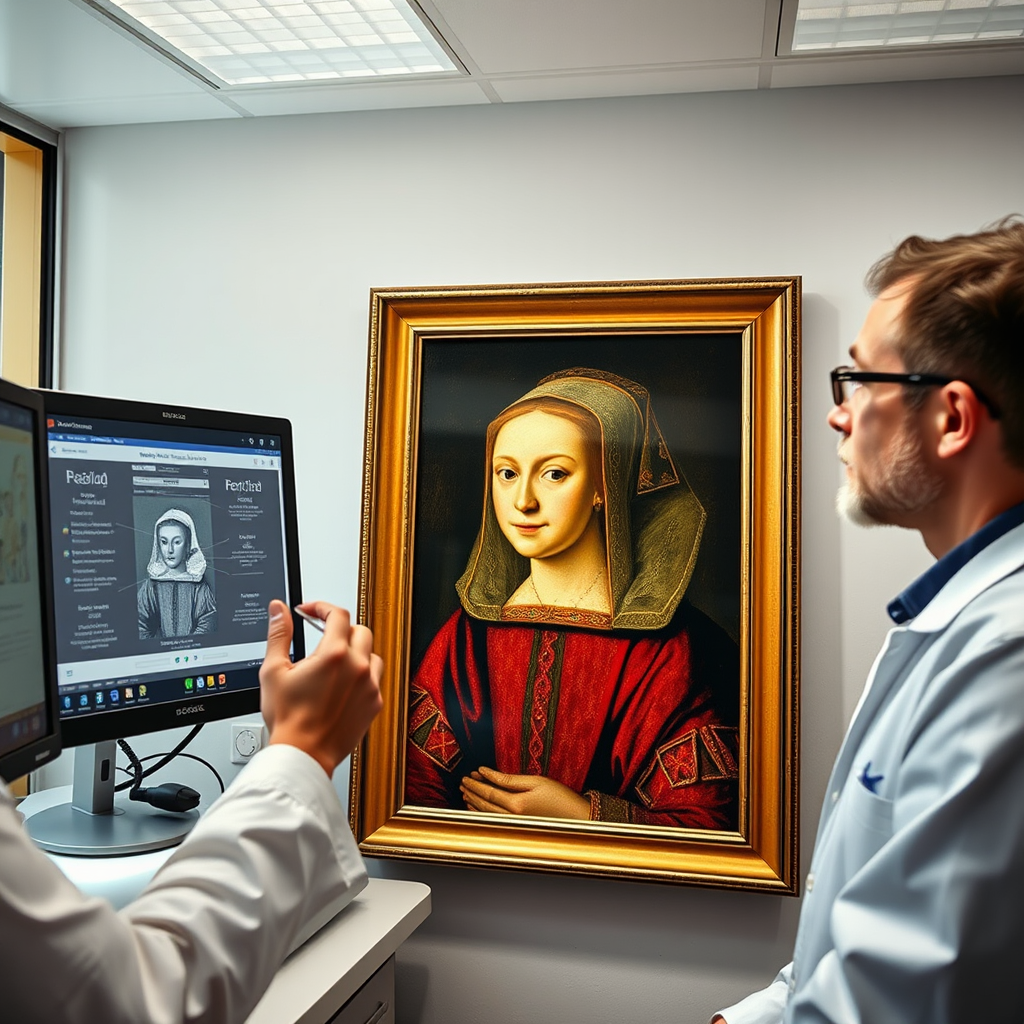

A tech-driven investigation is shedding new light on a historical question that has puzzled experts for hundreds of years: what did a Tudor queen really look like?
Scholars and researchers at the University of Bradford have unveiled findings that challenge the accepted identity of a portrait long believed to depict Anne Boleyn. The artwork, part of the Royal Collection and historically credited to Holbein, may have carried the wrong label for over two centuries.
This research coincides with the 490th anniversary of Anne Boleyn’s execution. The team applied facial recognition technology, created at the university, to analyze two separate Holbein drawings housed in the Royal Collection.
Professor Hassan Ugail, who heads the Centre for Visual Computing at the University of Bradford, emphasized that their work does not seek to override expert analysis. Rather, they have developed a mathematical tool that can either support or question attribution theories when conventional evidence is incomplete.
The conventional drawing, catalogued as RCIN 912189, has been identified as Anne Boleyn since the 1700s, based on an inscription added centuries after the artwork’s creation. However, the research establishes that no traceable provenance connects the piece directly to the queen, rendering that inscription unreliable.
The research team turned to artificial intelligence and historical documentation to pit this traditional depiction against another Holbein sketch, numbered RCIN 912190, currently labeled as ‘An Unidentified Woman.’
Karen L. Davies, an independent historian who spearheaded the project, explained that the investigation sought to determine whether the existing attribution warranted revision. She clarified that they did not begin with a predetermined conclusion and manipulate evidence to support it. Instead, they examined historical records first and then evaluated the facial features. The technology did not formulate the hypothesis; it merely revealed correlations.
The ‘Unidentified Woman’ drawing aligns with period accounts describing Anne Boleyn as having dark hair, a slim build, and a slender neck. Additionally, the sketch bears a notable similarity to a young portrait of Elizabeth I, Anne’s child.
The team employed a deep learning system named AdaFace, which calculated a 76.9 percent resemblance between the unidentified woman and Elizabeth I—a figure consistent with what one would expect between close family members.
Conversely, the conventional portrait shows a blonde woman with a fuller face and prominent double chin, characteristics that contradict contemporary accounts of Anne Boleyn’s appearance.
The study also pointed out that merely 14.8 percent of Holbein’s surviving preparatory drawings can be confidently identified using contemporary sources. The majority depend on later annotations, which frequently prove inaccurate.
Professor David Stork from Stanford University, who participated in the study, observed that Holbein’s drawings served as working references and technical guides for painted portraits. This quality makes them particularly appropriate for biometric analysis, which examines bone structure and facial proportions rather than hairstyles or clothing.