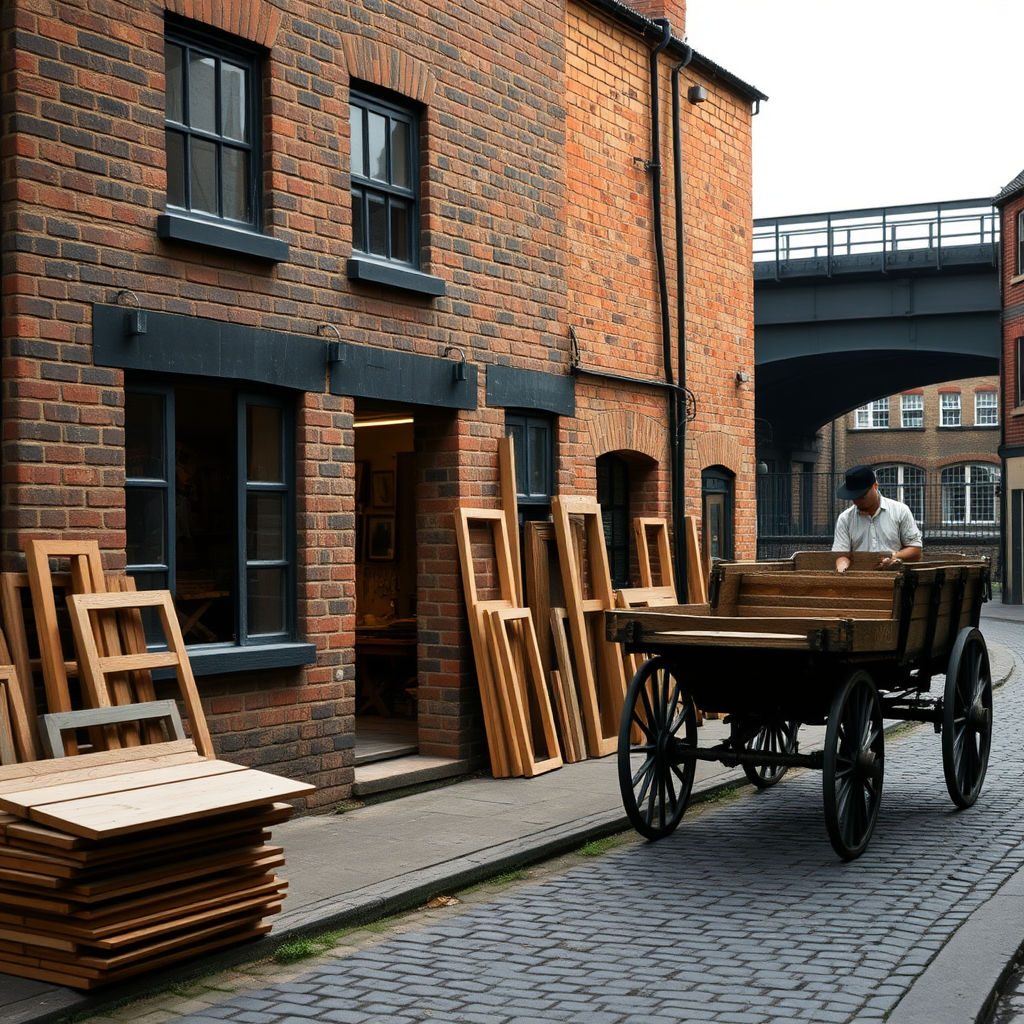

FEW people will associate Magnet Trade, Retail and Magnet Kitchens, all recognised national names, with the humble beginnings of Magnet in Bingley.
The company has developed and evolved, through recessions, two World Wars, industrial disputes and a number of mergers both within and outside the UK.
This article traces the early days of Magnet founded by Tom Duxbury in Bingley up to his death in 1948.
* 1871 to 1899
Tom Duxbury was born in Bingley in 1871 and married his first wife Sarah in 1894. His grandfather Thomas and father Robert were greengrocers, latterly on Mornington Road, Bingley and Tom followed them into the business.
Duxbury’s greengrocers in Bingley. Magnet founder Tom Duxbury’s father and grandfather were greengrocers
* 1900 – 1910
Robert died in 1906 leaving Tom the business which he sold in 1906 to Robert Hargreaves, father of his second wife. Records show Tom and family living at Whitley Street from 1901. Legend suggests that he sold his horse Magnet to set up a firelighter business.
* 1910 – 1920
Tax returns for 1910 show Tom running the business, a workshop, stabling and a wood shop. The 1911 Census identifies him as a a Firelighter Manufacturer working at Whitley Street.
Tom Duxbury set up a firelighter business in the early 1900s. This ad is from 1910
During the First World War he continued to run the business, buying Government Surplus cardboard and wood processed into firewood and firelighters.
In 1919 he set up the Magnet Timber and Hardware Company, separate to the firelighter business. Initially he bought and sold Government Surplus Stock.
* 1920 -1930
The decision for Magnet to diversify prompted Tom and sons Harry Lewis and John to consider selling some of the firelighting machinery which they advertised in local papers in March 1922. This was the precursor to eventually selling this side of the business off completely in January 1926.
1926 marked the marriage of Tom to Ellen Hargreaves in June following the death of Sarah Duxbury in 1923. The electoral rolls show them both living at 6 Whitley Street together from 1926 until 1931.
An advert for the company from the 1930s
A significant event was the diversification of Magnet into the retail joinery trade producing doorframes, doors, windows and moulding for local builders. The renamed Magnet Company was launched in 1927, having found a gap in the market and was by 1928 supplying components for houses being built throughout the UK.
In 1929 there was a major fire at the Timber Yard Works on Whitley Street which meant that the factory had to be rebuilt and the machinery updated. Ellen Duxbury loaned Magnet the money to enable this to happen.
* 1930 – 1940
After a long association with Whitley Street for the Duxbury’s, Tom and Ellen moved in 1932 from Bingley to live at High Point, East Morton.
In March 1936 Tom announced Joint Service Agreements for sons Harry Lewis and John Duxbury. In July 1936 the Company’s intention to become a public limited company known as Magnet Joinery Ltd was announced.
Tom Duxbury stated: “The Magnet Company Limited was formed in 1927 for the purpose of acquiring the business founded by me in 1919 and known as the Magnet Timber and Hardware Company. The business which has expanded progressively consists of the production of moulded woodwork and standard joinery which is supplied to all parts of the country.
“The company owns moulding mills and joinery works at Whitley Street, Bingley, fronting the Leeds and Liverpool Canal and connected with the LMS railway sidings by overhead conveyors.
In close proximity to these works the company owns freehold property of over two acres at Healey Lane, Bingley with a frontage to the LMS railway main line, both these properties being used for additional storage purposes.”
In 1937 Tom decided to build a factory in Gray’s, Essex intending to make and sell joinery in the South. Magnet became one of the largest wooden window and Stormproof windows in the UK.
* 1940 to 1948
However, with the advent of the Second World War, orders dried up but to supplement lost orders Magnet received Government orders for wooden components, including Nissen Huts and ammunition boxes. Doors and windows were also produced for blitzed areas of the country and parts for prefabricated houses were also manufactured. Women workers were recruited to replace male workers who had joined up.
In March 1942 Tom bought a sawmill in Knaresborough to ensure a supply of home grown timber, imported timber being difficult to obtain. In 1946 it was decided to open a factory in Birmingham.
Tom died in February 1948 and besides his notable business acumen is also recognised for his 30 years active religious work with Bingley Baptist Church.
* Images courtesy of Stephen Duxbury and Bingley and District Local History Society.